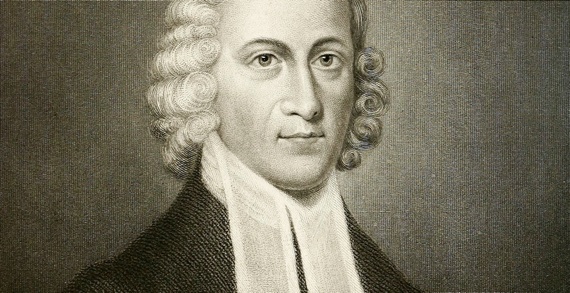
 In a world created by God, all things are related to God. We don’t always recognize this, but theology is not merely the analysis of the traditional subject matter. Theological study is the investigation of all things as they relate to God. Jonathan Edwards understood this clearly. Whether he was exploring the concept of original sin or the nature of the spider it all pointed him back to the God of Scripture. Edwards believed in the harmony of all knowledge. Edwards models a better approach to theology for average Christians today who have settled for a theological compartmentalism.
Edwards grew into a thinker in a remarkable age. It was the age of influence from thinkers like John Locke and Isaac Newton. Influential philosophers like Leibniz, Malebranche, and Bishop George Berkley were referenced and read by many. Edwards was probably not familiar with all of them, but his work and theirs often parallel each other. His was clearly influenced and shaped by Locke, though not a Lockean himself. He was also surely influenced by Ramist theory. Ramism had taught a principle of universal relationships, where humans saw shadows of a more perfect reality residing in the mind of God. The thinkers of Edwards’ day were concerned with establishing an “encyclopedia” of all knowledge. George Marsden summarizes Ramist theory when he writes:
All things in God’s universe were related, and the goal of learning was to recognize the circle of relationships. If one started from the right premises, drawn from Scripture, reason, and observation, one could be confident in the ability to discovery the order of reality because it was a manifestation of the perfect patters in the divine mind. (Jonathan Edwards: A Life, 76)
Edwards could look at nothing apart from his theological lens because there was no other lens through which to see things correctly.
Typology became a particularly useful tool in building his encyclopedia of knowledge. Typology was the practice of discerning types in Scripture that ultimately pointed to Christ. Jonathan applied this same practice to the universe as a whole. Again Marsden writes:
The universe, then, was a complex language of God. Nothing in it was accidental. Everything pointed to a higher meaning. Scripture, which itself was filled with types, was the key to reading the true meaning of everything else. They types in Scripture (for example, Joshua leading the people of Israel into the promised land) all pointed ultimately to the redemptive work of Christ. Nature needed to be interpreted as containing the same message. Everything was a symbol pointing either to the need for redemption or to some aspect of God’s character and the redemptive love in Christ. (77)
The world was his theological text. “Edwards was developing his physics and his metaphysics in relation to the central component of his thought, his theology” (76). Everything was related to God, pointing the creation back to its divine Creator.
If some of this ideal tends towards a version of Platonism, there is nonetheless a truth to it that ought to be recovered by Christians today. The whole universe is declaring the glory of God (Rom. 1:20; Psalm 19:1; Isa. 6:3). If Edwards might have tended to over-spiritualize the world, many Christians today tend to under-spiritualize it. We compartmentalize our faith and our theology. We think of our world in relation to God a few times a week, but the rest of the time it is simply “life”. Life is just what we see, what we experience. It has no deeper meaning, no relation to God. It compels no worship from me, nor does it cause me to think on the state of my soul. It is simply life. My marriage is just that,”my marriage.” My money is just “my money.” The spider dangling from the rafters is just a “bug” to be squashed. Nothing more.
We can learn so much from Edwards who had a bigger vision and a bigger theological scope. For far too many see theology as an abstract discipline or a self-contained Bible study. Edwards saw all of existence as having theological value. It was all a manifestation of the character and person of the Trinity and it called all of creation to worship God in response to seeing it. Wrestle with the world around you and see the myriads of ways, friends, that it can point you back to your Creator and Redeemer.
 Sparrow & Heart Soul Care