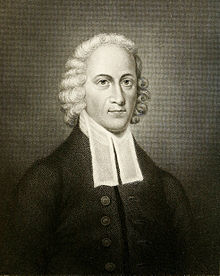
 To describe a Puritan view of discipleship you really need only one phrase: Bible-saturated. The Puritans were men and women who loved the Word of God. They saw it as vital to their own spiritual thriving and growth. They viewed their lives as a constant preparation for death, for their meeting with God. And so they consistently prepared themselves for their encounter with God by encountering Him again and again in His Word. Jonathan Edwards, as an heir of the great Puritans, saw his own growth by means of consistent study of the Word of God.
“Saturated” is a key term for understanding Puritan discipleship. The Word of God was not just a part of their Christian growth, it was the vital part. It permeated every area of their lives. It started, however, in Puritan Preaching. Preaching was understood by these devout Christians as extremely instrumental in discipleship. Unlike much preaching today, the Puritan sermon focused on explaining the Word of God. J.I. Packer observes that the Puritan sermon was marked by eight common characteristics:
- Expository in its method
- Doctrinal in its content
- Orderly in its arrangement
- Popular in its style
- Christ centered in its orientation
- Experimental in its interests
- Piercing in its application
- Powerful in its manner (A Quest for Godliness, 284)
Christian growth depends, and the Puritans understood this, on our learning of and from God. You cannot grow as a healthy Christian apart from the life-giving Word of God. Preaching was educating the church, and for that reason the sermon often went beyond the pulpit.
Mark Dever states that “[The Puritans] realized that in preaching their sermons well, they would be educating the church. That’s why they would encourage families to rehearse the sermons at the dinner table” (“The Value of the Puritans for SBC Ministry” in Reclaiming the Gospel and Reforming Churches. 624). Discipleship didn’t just happen on Sunday mornings. The Puritans saw, in addition to preaching, that Catechesis was an important part in Christian growth. The memorization of the Catechisms and Creeds of the church not only educated them on key doctrines of the faith, but it helped cement them into the long-term memory of the church. After all, what good is the doctrine if you can’t remember it when you most need it. Winfield Bevins, for whom I am indebted to for much of this material, explains Catechisms this way:
A catechism is the process of instructing believers both young and old in the basics of the Christian faith. Catechisms provide basic summaries of the church’s teachings to ensure that all members of the church understand the essentials of the faith for themselves. Most catechisms generally have questions and answers accompanied by Biblical support and explanations. (Discipleship in the Puritan Era, Part 1)
Richard Baxter is well-known for his role in the discipleship of his congregation. Baxter’s Reformed Pastor is essentially a call for pastors to take serious their job to educate and train their people. Baxter spent time in every home of ever member of the church asking them questions from the Catechism and teaching them. He took seriously the value of Catechesis. The Puritans understood that you could not count on the sermon alone to produce disciples, that required intentional training and genuine effort on the part of the Christian to grow. So memorizing the Catechisms and Creeds was a tool in helping Christians understand more and more the truths of God’s Word.
But all the head knowledge in the world was useless without real life application. Despite what many think, the Puritans were not just about abstract theologizing. They did not just have their heads in the clouds. Their devotional writings reflect an awareness of the Christian life that many authors in the so-called “Christian living” category lack. They understood that life was fleeting, that the Devil’s devices were cunning, that Christian obedience was necessary if difficult, that the Holy Spirit was active and powerful, and that the Word of God was living. They were prolific writers. Bevins notes just how prolific:
William Perkins’ writings totaled over 2,500 pages and were translated into half a dozen languages. John Owen’s works are collected in 24 volumes-including his large work on the Holy Spirit and his 7-volume commentary on Hebrews. John Bunyan wrote 60 books over a 30 year time period. Richard Baxter also wrote an impressive 1143 pages which included various topics from pastoral ministry to dying well.
And the breadth of the topics they address is wide. Every area of life required that the follower of Jesus think about it Biblically. And each of these varied writing reveals a depth of thinking that, once again, is often lacking in modern Christian authorship. Saturated with quotations from the Scriptures, the doctrines were always grounded in Scripture and the life application built upon the Word of God. These were not just opinions and man-made strategies. As the Puritans wrote about living the Christian life they did so from the Word of God itself.
As Jonathan grew in his Christian faith it was as an heir of the Puritans. He was very conscious of his own self-deception. He had repeatedly given signs of conversion but to no lasting reality. So after his conversion he was very cautious and very diligent to stay in the Word of God. Growth for this pilgrim happened as he poured over Scripture, saturated his mind with thoughts of God, and devoted himself to reading the writings of his great forebears. We can learn a lot from such a model today.
Often church growth experts talk about assimilation strategies, busying new Christians with ministry work, or developing “follow-up” programs for new believers. There may be some value in those ideas, but the truth is that real discipleship comes as we spend time with God, in his Word, and with his people. Discipleship doesn’t have to be some formal program. It is merely an intentional effort to know God more deeply on a consistent basis. Maybe less programming and more basic Bible study would make a real difference in our contemporary churches. The Puritans saw the value of such things, and because of it the little flame of Jonathan Edwards’s fledgling faith grew into a glorious blazing fire. That is the power of the Word of God in making disciples.
 Sparrow & Heart Soul Care