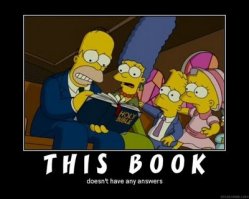
 To say that Homer Simpson misunderstands the Holy Scriptures might be considered a huge understatement. His interactions with his son Bart on the subject matter of Scripture reveal this understatement. After finding out that Bart has shop lifted Homer begins to lecture the boy on his bad behavior. He says:
Haven’t you learned anything from that guy who gives those sermons at church? Captain whatshisname? We live in a society of laws. Why do you think I took you to all those Police Academy movies? For fun? Well, I didn’t hear anybody laughing! Did you? Except at that guy who made sound effects. Where was I? Oh yeah, stay out of my booze.[1]
For Homer the Bible is a judicial book. It’s a book simply of rules and regulations. He recognizes that the Bible, i.e. the book Reverend Lovejoy (Captain Whathisname) preaches from, has something to say about stealing. He, of course, doesn’t know what that book says about stealing, but he at least recognizes it as a moral authority. But worse than Homer’s ignorance of Scripture’s moral commands is his assumption that that is all for which the Good Book is “good”. Homer sees no real value in the Bible. In fact in The Simpsons Movie, as crisis strikes Springfield Homer runs to the Bible for answers and concludes “this book doesn’t have any answers.” In a real show of his thoughts on Scripture, in “Co-dependents Day,” Homer carries around a hollowed out Bible in which he carries his flask. The Bible, for Homer, is a hollow book. There is a lingering Christian worldview in Springfield, however, where people readily recognize that the Bible is supposed to be important and have authority, even while the townspeople don’t find value in it in their current culture. It’s a statement that rings true for our own culture, of course, and that’s part of the goal of The Simpsons: to resonate with its audience that it might give some critique of our current cultural climate through the use of humor and satire in particular. This is the point upon which author Jamey Heit builds his thesis for the book Springfield Reformation: The Simpsons, Christianity, and American Culture. It’s a fascinating book, though I think his thesis might be a bit overstated. Nonetheless, it is my goal for this article to explore how The Simpsons view the Bible itself and Heit offers some helpful thoughts on this subject.[2]
Homer’s attitude towards Scripture is evident throughout the series and among a wide array of characters from the show, Heit demonstrates this well. The town’s relationship with the Bible finds them ignorant of its contents and its contents irrelevant for their lives; yet, because there is a historical value remaining on it people continue to appeal to it as an authoritative source. The manner in which they make this appeal turns us on to both the influence of the postmodern hermeneutic applied to Biblical interpretation and an honest, if humorous, critique of it.
 Sparrow & Heart Soul Care
1 Comment